
Knowledge base
Address Types Explained: Legacy, SegWit, Native SegWit and Taproot
The style of an address — the prefix, the script, the encoding — tells you which derivation scheme and network a wallet was using. Getting it wrong is a classic zero-balance cause.
Short answer
An address type is the format of the locking script an address represents and maps to a derivation scheme (BIP44/49/84/86). Restoring with the wrong address type shows a zero balance even though the funds are intact.
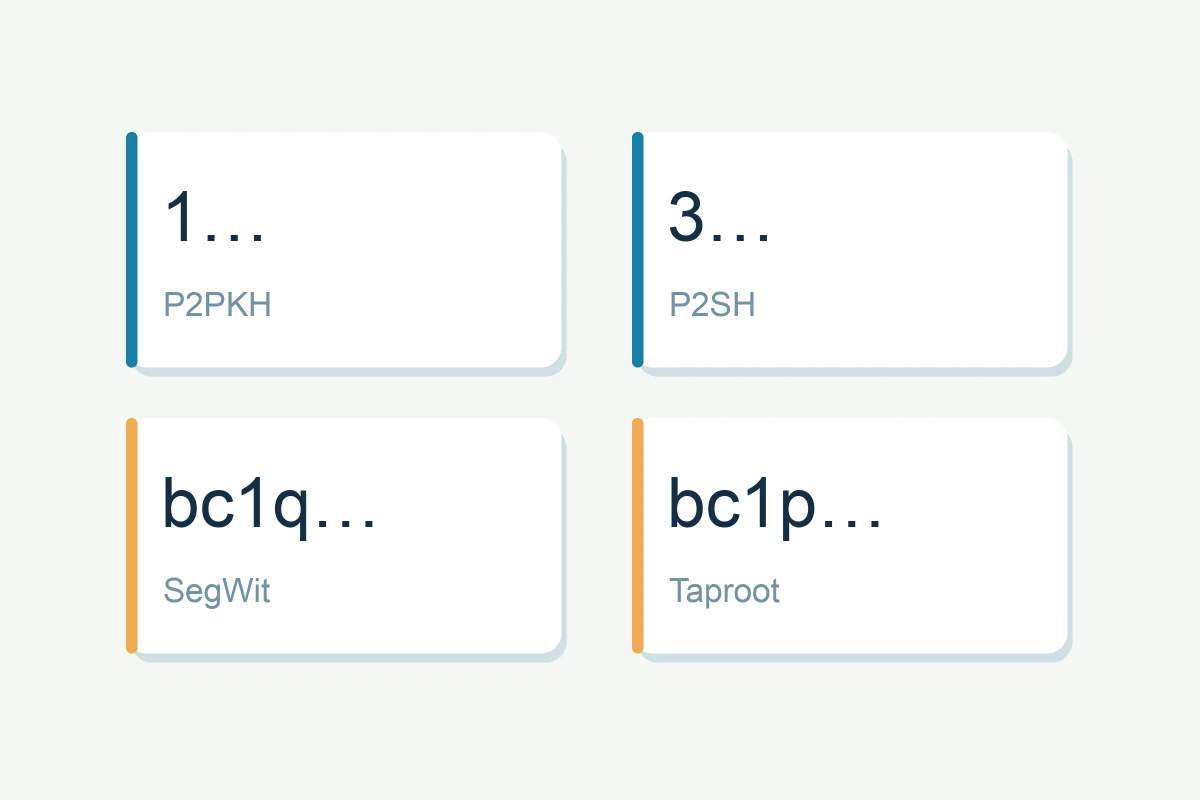
An address is a rendered form of a locking script. Its prefix and encoding reveal the address type, which in turn maps to a derivation scheme (BIP44, BIP49, BIP84 or BIP86). When a restored wallet shows a zero balance, checking the address type is often the fastest way to find the problem.
The main Bitcoin address types
- P2PKH (legacy): starts with 1, derived under BIP44 — the original pay-to-public-key-hash script
- P2SH: starts with 3 and commits to a script hash. It supports several script types, including multisig and nested SegWit; BIP49 is the nested-SegWit case, not a rule for every P2SH address.
- Native SegWit (bech32): starts with bc1q, derived under BIP84 — the SegWit output directly
- Taproot (bech32m): starts with bc1p, derived under BIP86 — the modern single-key output
The same seed can hold funds on several of these at once. A wallet that defaults to one type will simply not show the others until you switch type, add accounts or increase the gap limit.
Coin-specific variants
- Bitcoin Cash: CashAddr (starts with bitcoincash:q or q...); the legacy 1.../3... forms also exist on the BCH chain
- Litecoin: L-addresses (legacy), M-addresses (SegWit), ltc1 (native SegWit)
- Dogecoin: D-addresses
- Ethereum: 0x addresses with EIP-55 checksum casing; the same address works across EVM chains, but tokens must be on the right network
- Ripple: X-addresses (also r...; the X form encodes the destination tag)
- Cardano: Byron addresses start with A...; Shelley addresses start with addr1... or stake1...
- Polkadot and Substrate: base58 strings with a network prefix; the same key material renders differently per chain
- Monero: 4... addresses (standard) or 8... (subaddress)
- Solana: base58 addresses
- Tron: T-addresses
Why this matters for recovery
- The address style is a strong clue about which derivation path and network the original wallet used
- Restoring a seed with the wrong address type produces valid-looking but empty addresses, not an error
- A known receiving address from the original wallet is the best anchor: it lets recovery software test derivation paths and passphrases against a real target
- An address cannot restore access by itself, but it can confirm whether a wallet is looking in the right place
Still locked out?
The first assessment is free, and it asks for no wallet secrets. Describe what you still have — a file, a phrase, a device, or what you remember — and we’ll tell you whether recovery is realistic. You only pay if the recovery succeeds.