
Knowledge base
Extended Keys and Watch-Only Wallets: xpub, xprv, ypub, zpub
An extended key is a BIP32 node: a key plus the chain code that lets a wallet derive a whole family of addresses. xpub/xprv, ypub and zpub are the common encodings.
Short answer
An extended key (xpub, xprv, ypub, zpub) is one node in the HD key tree: a key plus the chain code needed to derive its children. An xpub is safe to share for watch-only use; an xprv is a master key.
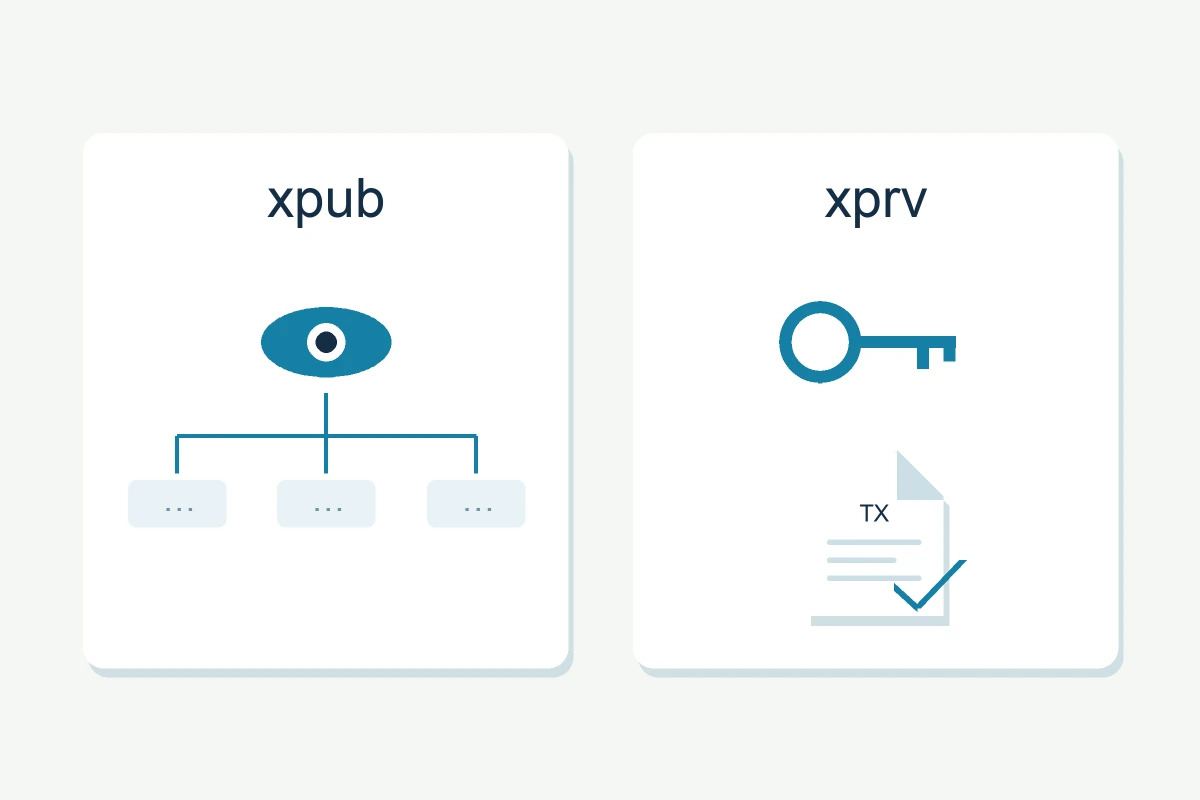
An extended key is a BIP32 building block: one node in the HD tree, containing a key and the chain code needed to derive its children. That is why a single string such as an xpub can regenerate an entire family of addresses, and why losing a private key is not the only way access disappears.
The common encodings
- xpub / xprv: the original BIP32 encoding (base58, starts with xpub or xprv)
- ypub / yprv: used for SegWit-in-P2SH (BIP49) address families
- zpub / zprv: used for native SegWit / bech32 (BIP84) address families
- tpub / tprv and their variants: testnet equivalents
The prefix is a display convention, not a cryptographic difference: the same key material can be encoded several ways. Some wallets add their own prefixes for other address styles.
Watch-only wallets
An xpub (or ypub/zpub) lets software derive receiving addresses and watch balances without being able to spend. That is useful for monitoring and for read-only views - and it also means anyone who gets the xpub can see every address the wallet has used and its full balance history, even though they still cannot spend from it. Watch-only cannot sign or move funds.
Imported keys and keypools
- Imported keys are individual private keys added to a wallet outside the HD structure; they are not part of the seed-derived tree and are not restored by a seed phrase
- A keypool is the pre-generated set of addresses a wallet keeps ready; old wallets (for example early Bitcoin Core) relied on keypool files, which is why a wallet file, not just a seed, mattered
- Output descriptors (for example wpkh([fingerprint/84'/0'/0']xpub/0/*)) describe an entire address family in one string; modern Bitcoin Core uses them
What this means for recovery
Finding an xpub does not unlock funds on its own, but it helps compare derived addresses after a restore. Its metadata includes the depth, parent fingerprint and final child number, not the complete original derivation path; that origin needs separate records or verification. A watch-only wallet cannot be turned into a spending wallet without the private key or seed behind it, and if you only have an imported key, that key or the wallet file holding it is the recovery material itself; no seed will restore it. Because extended keys follow BIP32, a wrong path applied to the same xpub still produces valid-looking addresses — just the wrong ones.
Still locked out?
The first assessment is free, and it asks for no wallet secrets. Describe what you still have — a file, a phrase, a device, or what you remember — and we’ll tell you whether recovery is realistic. You only pay if the recovery succeeds.